Not likely. Mulberries grow on trees, big trees. Well, maybe not big as in...black walnut but you aren't going to just go out there and pick the berries off of it. Not without a ladder and a pretty big ladder at that.
I was amazed at the first mulberry tree I saw here. I really did actually think mulberries had to come in the form of a bush because of the children's song, of course. But my neighbor here has a mulberry tree and hers was the first I had ever seen. It is a rather huge tree that sits beside the dirt road in her front yard. She is quite proud of it though it is too big for anyone to ever reach the berries on it.
About a year after we moved in here I realized we had our own mulberry "bushes". One cropped up in the front yard. I cut it down. It came back. I cut it again. It came back. This is where I learned how tough the mulberry trees are. I must have cut that tree (and it was quite small) back 10 times and I mean right down to the ground and it came back every time. Then I started school and work and it got ahead of me. They grow incredibly fast! We now have a rather large mulberry tree, competing with the dogwood tree and one other for space in the smaller part of the front yard. (I have not identified that other tree but it grew even faster than the mulberry). The three of them provide some nice shade for the swing that is out there.
There are several different kinds of mulberries (morus) trees but the kinds we have here are either the native red mulberry (morus rubra) or the white mulberry (morus alba) which is an Asian species brought here to feed silk worms industry which never, apparently, materialized. The red mulberry is in danger because of hybridization with the white mulberry. I have no idea exactly which species we have here.
The berries are supposed to appear in small clusters of 2 or 3 but ours are almost always single berries and not a whole lot of them. I bet our tree doesn't have more than 25 or 30 berries on it- if that. They start out a greenish white and then turn redder to a dark purple just like a blackberry does. They taste quite like a blackberry as well but they do have a stronger flavor which is hard to describe.
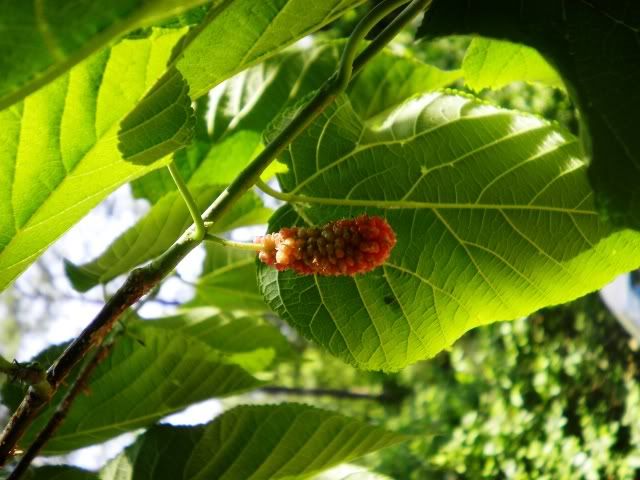
I got lucky to find one branch drooping low enough so that when I raised the camera as far as I could I got a picture of one of the berries. It is obviously not ripe yet.
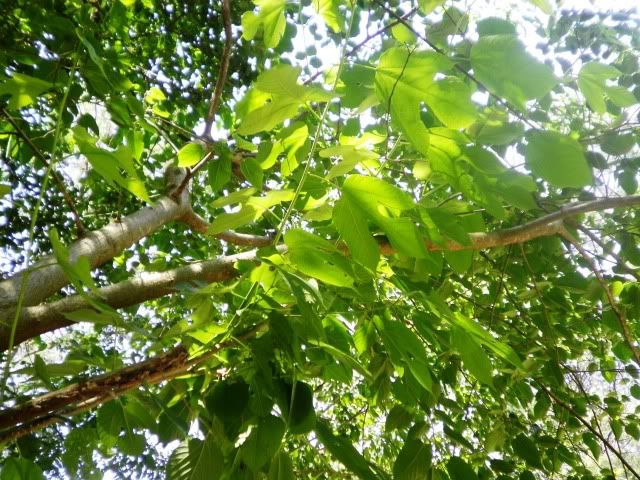
The leaves on a mulberry tree are rather strange. They start out lobed and then as the branch gets bigger they are no longer lobed and the sides are just tear drop like (well not really but I don't know how to describe it--leaf shaped, lol).
Here is a picture I took of the lobed leaves on some of the shorter branches but if you look to the bottom you can see how some of the other leaves aren't lobed.
I do collect what berries I can reach but it is usually not more than a couple which are eaten right then. The birds and squirrels get the rest.
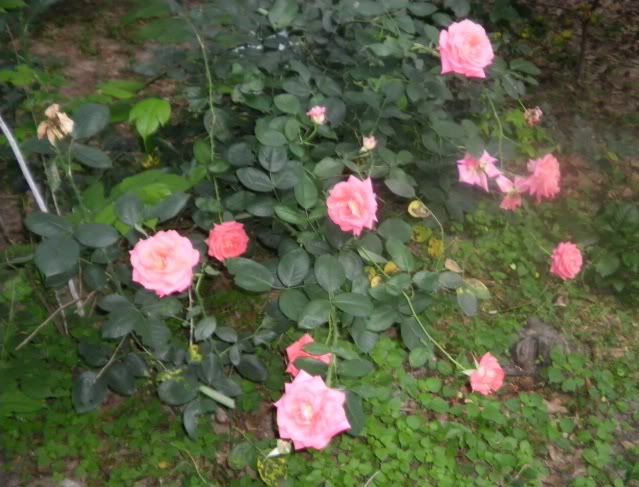
I am not done with my fight against mulberries however. Mulberry trees grow from seed and a seed has made its way to the back yard. If you look at this picture of the rose bush that I posted the other day you can see a few lobed leaves to the right. This is right in the middle of the back yard.
I'll just keep cutting it, I suppose.
Saturday, May 5, 2012
Thursday, May 3, 2012
Update for May
This may turn out a bit long since I took so many pictures this morning but here goes anyway. We'll start with something pretty this time. This rose bush is in the back yard and usually only blooms a few blooms but this year it is putting on a show.
Here are the asparagus ferns climbing all out of their fence again. I need a taller fence and I need to plant a few roots in the middle as those did not seem to make it. I hope to have some asparagus to eat next year.
Phil was kind enough to cut back some of the lemon balm. He only cut the stuff that was growing out on the pathway (or where the pathway should be in front of it but as you can see it is reaching out to spread some more.
I actually made it down to the garden today and the one large squash plant caught my eye. I haven't gotten down to the garden this week and in just 4 days it had grown so much! It has baby squash and I took a picture but then had too many pictures and that one didn't make the cut. If they actually go on to become big squash you'll get a picture then.
My beans also came up. Now if the bugs and deer will just leave them alone maybe we can have a few fresh beans this year.
Farmgirl Friday
Here are the asparagus ferns climbing all out of their fence again. I need a taller fence and I need to plant a few roots in the middle as those did not seem to make it. I hope to have some asparagus to eat next year.
Phil was kind enough to cut back some of the lemon balm. He only cut the stuff that was growing out on the pathway (or where the pathway should be in front of it but as you can see it is reaching out to spread some more.
I actually made it down to the garden today and the one large squash plant caught my eye. I haven't gotten down to the garden this week and in just 4 days it had grown so much! It has baby squash and I took a picture but then had too many pictures and that one didn't make the cut. If they actually go on to become big squash you'll get a picture then.
My beans also came up. Now if the bugs and deer will just leave them alone maybe we can have a few fresh beans this year.
Here are some of the tomatoes and a picture of the blossoms.
Here are the tomatoes in the baskets on the porch. There are several little tomatoes now.
Here are some of the lemons on the meyer lemon tree. The lemon tree is rather strange because it has these little lemons all over it but it is still producing blooms as well. I am trying very hard to remember to water it and the tomatoes in pots. Watering things in pots is usually where I failing every year but this tree costs too much to let die.
Here is a picture of one of the fig trees. It had figs on it but either dropped them or the birds or squirrels got them. I never seem to get any. Same thing with the one in the back yard. I believe these have only been planted 3 years now but it could be 4 years. 

Here are the meat birds, growing nicely and looking nasty like always. This was early this morning. I'll get some more hay in there when I feed them and I need to take that light out as they don't need it anymore.
Here is the duckling and the bantam chicks (and one quail-I want to give them a few more weeks before I add them to the others). The duckling is growing so quickly. I will likely get a pen set up for them this weekend and get them moved out of the greenhouse.
So I guess I will stop there. Pictures take so long to load on photobucket and I have to get everyone fed. I did get the garden watered this morning again. The rain barrel is only about a third full now which is still good for another watering. There is also water in the bucket in the greenhouse that is a rainwater catchment from the greenhouse roof.
Farmgirl Friday
Tuesday, May 1, 2012
The Black Walnut (juglans nigra)
I read somewhere that black walnut trees were once planted
on farms to bring good luck. When I was
a kid and we lived in my grandmother’s house there was a black walnut tree that
had been planted out back in on the edge of the woods.
I suppose people back then would have known not to plant the
black walnut near where they were going to grow anything though they may not
have known the name for the toxin the tree produces, juglone, which is lethal
to most plants.
New England where my grandmother’s house is located is not
the best climate for growing black walnuts as they prefer warmer less acidic
soil but no one told the black walnut trees that for I can remember there being several others on farms nearby as
well.
At one time the tree was quite common but in colonial days
it was used extensively because it didn’t easily rot when exposed to
soil therefore, it was used for railroad ties and split rail fences. It also does not split, warp or shrink so was
a favorite wood in New England for making gun stocks.
Later people often considered it a nuisance, as did my
mother, because, of course, of the nuts dropping. Ours was at the edge of the woods so we didn’t
have to clean it up but my mother considered it a nuisance because my father
had taught we kids that we should bring the nuts home and throw them on the
roof to dry the outer husk of the nut. I
have since learned that if removed when the husk is still green the nut tastes
better but we let them dry because the husk if removed when green will leave
your hands stained brown and the stain will only come off with time. In order to crack the nut after the husk
dried, my father raked the nuts off the roof and we put them on a tarp in the
driveway. He then ran over the nuts
several times with whatever vehicle we happened to have at the time.
Our black walnuts were just treats for us. I don’t remember
my mother collecting and using them for anything but historically black walnuts
had many uses. The Abneki and other
Native Americans used a liquid made from the nutmeats as a substitute for
mother’s milk. Early European settlers made
a hair dye, wood stain or ink from the husks.
Black walnuts are still harvested today with a commercial
harvest of 50 pounds million nuts. The shells
are used as well as an abrasive for polishing engine parts and as an ingredient
in cosmetics. Humans are not the only
ones that benefit from black walnuts.
Red, gray and flying squirrels eat the nuts and the leaves are a
favorite food of the luna moth caterpillars.
The wood is still quite valued as well so much so that in
recent years forestry officials have been called on to catch poachers. In 2004 DNA testing was used to solve one
poaching case that involved a 55 ft. tree valued at $2,500.
The largest black walnut is located on a residential
property in Sauvie Island, Oregon. It is 8 feet 7 inches in diameter and 112
feet tall with a crown spread of 144 feet.
Subscribe to:
Posts (Atom)


